Showing posts with label business photography. Show all posts

14 May, 2017

Portfolio Brainstormin'

As I've been working to update my portfolio for the first time since 2013 (when I took this picture), it's again occurring to me that the traditional sense of a portfolio as a collection of images-that-stand-alone doesn't really fit the kind of work I do. I feel like my dedication to storytelling and my focus on everyday moments are two distinguishing traits of my work. I try to get the aesthetics and style down as well, but I feel like they're less central to what I do.

But presenting those characteristics as part of an online portfolio still seems challenging. Among other things, phone screen aspect ratios make it challenging to lay out images and text together, such that the text is legible and the details of the image are still visible.

26 June, 2014

Light and Shadow

I need your help. I put my heart and soul into my photography, and into this photo blog, but I can't do it alone.

Let's talk about this photo. I love this photo. I was visiting the deYoung museum with some friends, and I spotted this tall window that allowed passersby to look over the courtyard. And then a member of the security staff stood in the window. Perfect. *click*.

This photo is a story of contrasts. The angles and corners and straight lines of the top, against the dark tones and organic curves below. The window breaks the broad, smooth expanse of gentle gradient in a way that draws the eye straight to it. But in the lower half, your eye is free to wander from detail to detail to detail.

This is where you come in. It was with the help of my supporters, particularly via Patreon, that I was able to afford the Fuji X-T1 camera which made this photo possible. If you love the photos I take, the stories I share, and my dedication to high quality publication, I would sincerely appreciate if you could take the time to support me on Patreon. That means that you would pledge some amount per blog post, with an easy-to-configure monthly cap, and I would earn that money by continuing to produce and share the high-quality content that you've already seen right here.

At the most basic level, your support will help convince me that my work has value, and that I'm on the right path. Sometimes I have doubts, just like any other creative person, and it means so much to me to have that affirmation. Beyond that, your support will help me shuffle the priorities in my life so that I can publish more regularly, and try more audacious experiments (blog R&D, if you will).

If now is not the time, that's absolutely okay. I will still continue to put everything I can into my photography, and into this blog. But priorities are priorities, and sometimes, the blog doesn't come first. If you ever have a change of heart, maybe after a particularly amazing post, there's a convenient red link at the top-right of every page. Just click that, and you'll be able to help me take this blog to the next level.

Sincerest thanks, to my current Patreon supporters, and to everyone else who reads or follows this blog,
--Omari Stephens

02 October, 2013

I need your help.

Howdy, y'all. I recently discovered a service called Patreon, and I've decided to give it a shot. Patreon allows anyone to pledge any amount of money (say, a dollar) per blog post that I publish. It also gives me a venue to interact directly with the people who are supporting my work, while still allowing me to keep the blog ad-free and freely accessible for anyone to enjoy. So if you like my blog posts and would like to see them more frequently, please consider supporting me on Patreon.

Why now? This blog has always been a labor of love. That said, my life is pretty full now, and I've noticed that I haven't been spending as much time writing as I'd like. But even so, it also felt difficult to prioritize the blog over the things that had come to occupy my time. In short, I've had to consider more closely how I spend my time and what I get out of that time.

How does Patreon help? For the blog, I have two primary goals. First and foremost, I want emotional satisfaction. I want to pour my heart into this thing, and get feedback that you appreciate what I'm doing. I'd also like for you to feel empowered to take some control over the content that I publish. Which posts should I work on first? Should I do another poem? How quickly do I need to publish about a current event for it to be useful? Patreon gives me a mechanism to identify some of the people who are willing to invest in the work that I'm doing, and at the same time gives me a way to offer them some ownership of the blog itself. That's a win-win in my book.

My second main goal is to have the blog contribute toward my photo business. Ideally, when I make investments of time, money, and energy into photography, I'd like to see a return that I can then reinvest in my photography. I'd like to be able to fix equipment and periodically purchase new equipment, both of which will help me do a better job of capturing and telling the stories that I witness.

At this point, returns from the blog have been few and far between, which sometimes makes it difficult for me to choose to invest the 2+ days of effort that go into each and every blog post (including this one). Patreon changes that equation by providing some assurance that I'll have a monetary return on the time I commit to blogging. In other words, if broken equipment keeps me from shooting, I can work toward repairing the gear by continuing to write high-quality blog posts. That's a pretty exciting prospect.

Why Patreon? I really dislike ads, and I want to share my work with minimal restrictions. If someone can't afford to get past a paywall or buy a subscription, I still want that person to be able to see and enjoy my work. L aptly described Patreon as creating an NPR-like model, where sponsors offer their assistance to maintain a free resource for the public good.

Why me? By becoming my Patron on Patreon, you can have a direct impact on the frequency, quality, and audacity of my blog posts. This is your opportunity to put your stamp on this blog.

Moreover, you'll have an opportunity to see a sample of photos I take, regardless of whether they ever make it onto the blog. To put this in perspective, in 2012 alone there were at least 50 shoots that never saw the light of day. So far this year, there've been at least 30. Do you want to see what they were? Do you want to pick the which photos deserve to get posted? This is your chance.

Any other questions? If you have any other questions, definitely leave me a comment on the blog, on G+, or on Facebook. As always, I will answer every question and respond to every bit of feedback that I receive. Thank you for reading this far, and I hope you decide to join me on this journey.

10 June, 2013

Long Day in the Studio

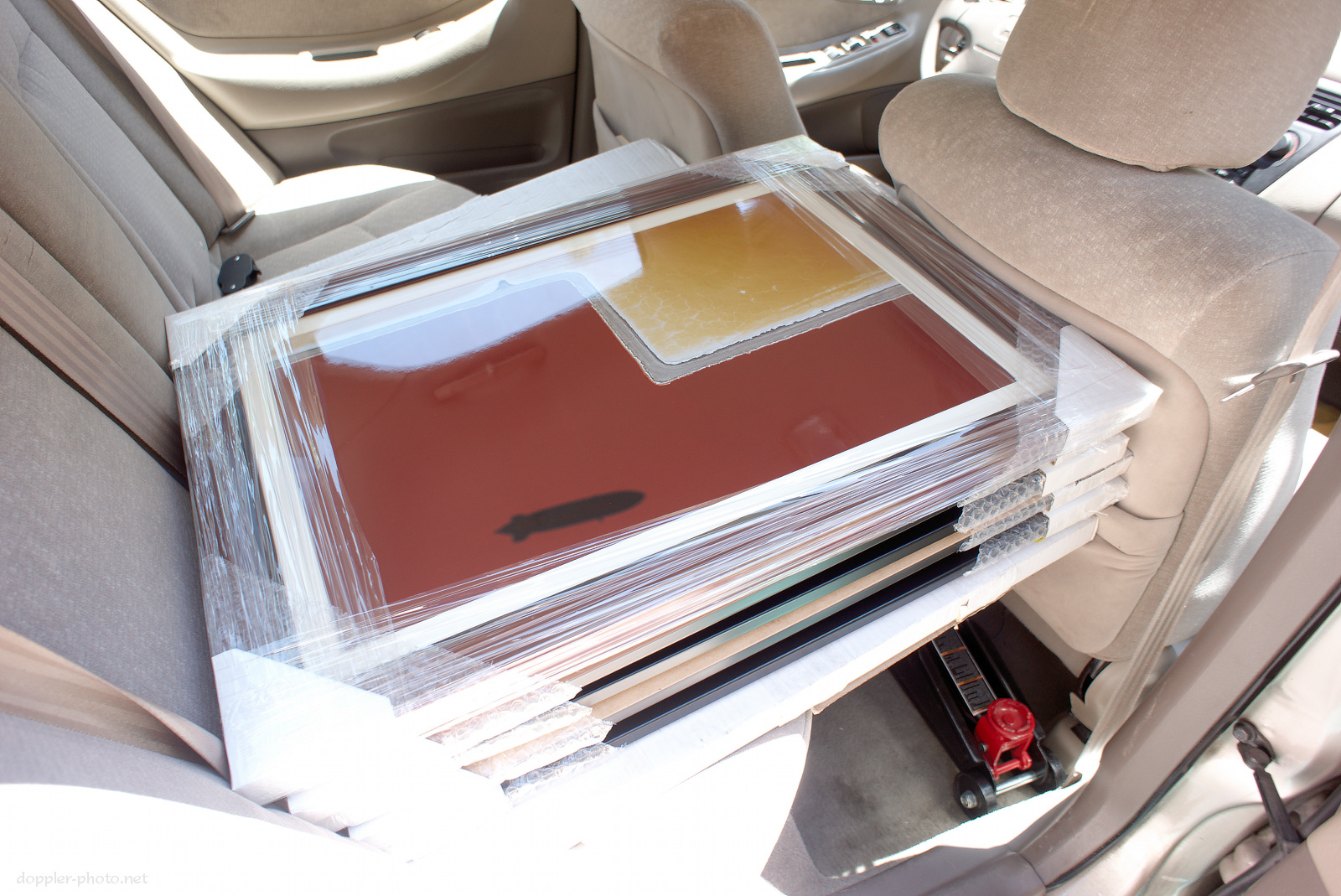
Yesterday, my Lovely assistant and I spent all day in the studio, working through the majority of the remaining images for my Photos of Prints project. We finally finished the last one (the snail, 24"x36") at 11:00 in the evening, and that's when things started getting a little silly.
I was really happy with how things turned out. I had only just finished the second version of the print hanging fixture that morning, and it worked fantastically. Which is nice, because those framed 24"x36" prints are heavy. We managed to get through 20 images — the 17 from my Music at Google exhibition, Mondrian Salt Flats, ENDIKA, and Keep Calm, Carry On (aka the snail :o).

Beyond that, I had an opportunity to use the amazing Coastal Optics UV-VIS-IR 60mm f/4 Apo Macro lens. As mentioned in the prior post, I had noticed some color fringing and optical distortion that I wanted to try to fix. Aligning things more carefully helped a lot with the keystoning, and the Coastal Optics did a number on the other problems. This is probably the only opportunity I'll have to shoot with one, so I'm glad everything came together. Thank you to the anonymous benefactor who let me borrow the lens.

22 May, 2013

An Ongoing Project: Photos of Prints

After having collected a startling amount of print inventory over the last couple years, I've started working on taking photographs of my prints in an effort to sell some of the inventory. Because I can't damage any walls of the studio, and because I wanted the images to "float" against a white background, I ended up designing and building a custom fixture to hold the prints to be photographed.

After finishing a prototype, I took the rig for a trial run, in what was my first time setting up and using studio strobes. I ended up using a ~7-foot octa as the key light, with some (not enough) reflected fill from the bottom. The other two lights are to (left) blow out the background, and (lower-right) blow out the sheet of paper hiding the exposed portion of the stand.
Nearly all of the pieces to be photographed are custom-framed, and thus are reasonably expensive and time-consuming to replace (and some are one-of-a-kind), so a combination of redundancy and over-provisioning was the name of the game. My spec for the system was to handle a 40-pound frame with near-zero chance of the frame ending up on the ground. The heaviest pieces I've done so far, two 24"x36" pieces with glass, should still fit within that envelope, and at this point I'm pretty confident that the system would be able to handle a minor earthquake without issue.

In the prototype, the two main pieces of wood are attached with two small bolts per plank, with a metal framing bracket actually connecting them. The final version will have a pair of brackets, tied together with three bolts, and holding the end of the horizontal plank flush against the back of the vertical plank.

The dowel is intended to locate the fixture both laterally and longitudinally in the head of the work stand. The stand's clamp closes on the dowel to prevent it from moving, and the dowel is again attached to the horizontal plank with bolts. The dowel is slightly wider than the planks themselves, which gives the setup plenty of strength to withstand any yaw forces.

Finally, the black thing near the left of the fixture is a self-tightening strap to lock the pitch of the fixture relative to the head of the workstand. The final version will need adjustable pitch (even if just using some shims and the same strap) to make it easier to square the face of the print to the orientation of the camera sensor.

Oh! I should note that I picked the Spin Doctor Pro G3 bike stand for its combination of portability, stability, robustness, and low cost. The large-diameter tubes are plenty rigid, and all of load-bearing components (including clamps) are constructed from metal.
This is the face of the carrier fixture. The wire hangers are rated for 30lbs each, and given their shape, are extremely unlikely to fail in the first place. For the final, I'll need to remember how to drive a nail ;o) I also did a poor job of laterally centering the fixture on the bike stand, but it seemed to make little difference. Even with the current two-bolt arrangement, the setup has plenty of roll stiffness and stability, thanks in large part to the ability to clamp the dowel.

This also shows the simple paper setup used to hide the central tube of the work stand. That sheet of paper is the "magic" of the floating effect, yet is probably the simplest part of the entire contraption.
This was the first image that I tried. On the plus side, the color tones of the print itself are great; this is the best it's ever looked, and demonstrates how it would look in a properly-lit environment. Beyond that, the lighting setup does a good job of conveying the rounded shape of the frame, especially in the top half.

In what would become a repeating theme for that session, the bottom half of the frame is under-lit, and consequently looks flat and lacks detail. Moreover, the frame looks decidedly non-rectangular. I wouldn't be surprised if this particular frame were out-of-square, but that appearance is definitely exaggerated by some keystoning (that is, the print and the camera aren't properly aligned).

Finally, the background light level wasn't set properly, and so the background isn't fully overexposed in this shot — with a good monitor, you can differentiate the sheet of paper from the backdrop.
This was the second image, and the lighting here definitely needs some work. The defining feature of this frame moulding is the combination of a matte-black exterior with a shiny piano-black interior. I managed to get a little light on the bottom of the frame with a reflector, but it's still got no real depth. I also need to add another light somewhere to illuminate the shiny surface of the piano-black band.

From a slightly more technical perspective, there's some combination of keystoning and pincushion distortion, as well as some chromatic aberration at the edges of the frame. Shooting with a macro/micro prime lens rather than a general-purpose zoom should clean a lot of this up, especially stopped all the way down to f/5.6 or f/8.
I again had some trouble with the lighting on this shot. The top-right corner is too hot, which is most apparent in the overexposure of the cream-colored mat. The colors of the print are generally pretty good, but as the light falls off from the top-right corner to the bottom-left, so does the color saturation. The frame is a tiny bit too hot in the top-right corner, but is under-lit almost everywhere else. Oh, well…

Welp, that's my journey so far. It's been pretty educational for me, and I hope y'all learned a little as well. Until next time

25 June, 2012

Woohoo! New cards!

I personally design and lay out all of my business cards. It's challenging, but it's also fun, and the process lets me inject a bit more of my personality and my aesthetics into what I do. Over the past few weeks, I've been working on a significant redesign of my cards; until this point, I've been using the same rear design that I came up with back in 2009. Man, how time flies…

This time, I wanted to focus more on the print-selling aspect of my business. As any frequent reader has undoubtedly realized, I take photos of whatever the heck piques my interest. I wanted the card to communicate that, and also to communicate the feeling that at least some of those subjects are worth hanging on a wall.

Yet the diversity of subjects makes it hard to define myself, and also makes it hard to define a target audience. So instead of defining the target as a group of people, I'm trying to think of them as individuals. They may not be "fans" of my work or anything like that, but I've shot this one picture that they love, and though they might not realize it yet, they want that print up on their wall. I mean, they've got to have it.

During this redesign, I've tried to keep that individual in mind. How do I reach that person? How do I let that person know I'm talking to him or to her, rather than just to Someone Else? Well, I went back to the basics. I know that he or she has an environment, and I know that he or she wants to be comfortable in that environment — you want to have a space that has your interests in mind, right?

So, who am I? What do I do? I sell prints of the things that people love.
Variation #1 for front: You're a kitty!
Variation #2: A blast from the past. This was the first good fire spinning photo I ever shot, from way back in 2004, and it's still one of my favorites.
Variation #3: I shot this at Ocean Beach on Christmas Day, 2009. Check out the awesome poem that I wrote!
Variation #4: I love self-portraits. I shot this one in the (blue) hood of my car. The sun was right behind my head, so that my reflection was outlined by my shadow. I've tried to reproduce this image, but haven't gotten any quite as nice as this one.

09 June, 2012

Awesome Things A-Brewin'

What's better than getting a beautiful print? How about getting that sucker custom-framed? This is a version of “Mondrian Salt Flats” that I just had done for the 2012 Kellicutt International Photo Show. I'm honored to have had that photo selected as one of the 45 finalists in the competition (from over 1000 submissions, I hear), and the last round of judging will be of the physical works, which will be hanging at the Coastal Arts League Gallery & Museum in Half Moon Bay.

I'm really excited about this print. It's on glossy paper, and my friends over at Bay Frames mounted it behind anti-reflective museum glass, which lets the vibrancy of the print really shine through. The moulding is the same as I used for the first framed version of the print; it's a nice, deep cherry color that fades to black as it reaches the mat. It complements the colors of the salt ponds perfectly. The image will certainly be up against some stiff competition, but I can't wait to hear what the judges think of it.
Some of you may recognize this as the same image that was selected for the Pictory Magazine's “Infrastructure” feature. Here's the story behind the image:
Viewed from “Eureka,” the largest airship in the world, the vibrantly-colored Cargill Salt Flats of Redwood City, California present a Mondrian-esque scene. After over a century of salt production, Cargill Salt announced plans in 2006 to decommission the flats. Now, six years later, debate continues to simmer over the future of the 1433-acre plot: many environmentalists want it to be restored as bay wetlands, while Cargill hopes to develop housing for 30,000 residents.

04 June, 2012

"Pride" is not a four-letter word

I wrote this a couple days ago to a friend of mine (also a photographer). I think it's applicable to all sorts of situations where one needs to represent him or herself, such as when writing entrance essays. Hopefully you find it interesting as well:


I think my own philosophy on modesty and pride is that all of us are on this path of learning. Some folks are farther along than others.
Modesty is knowing that I have a lot farther to go — a lot more to learn — and that there are people who are farther along the path than me.
Pride is knowing how far I've come to get to this point. It's knowing that there were compromises and hardships in making it to this point, and knowing that I am farther along this path than some other folks.

In my personal opinion, to sell my work, I don't have to pretend that I'm the best in the world; I'm not. But on the other hand, if the customer doesn't understand that I'm proud of where I'm at, regardless of how far I have yet to go, then I'm selling myself short. If the customer sees that I have potential, but doesn't also see that I have accomplishments, then I've got to change something to help them see the balanced picture.


My small suggestion in all of this is that if you're not excited about your portfolio, then keep practicing. But if you are excited about it, then you've got to let it out, at least a little bit. You have to realize that there are people who are better than you, but also that there are people who aren't quite as good. Clients have to know that you're excited about how far you've come, even if you're more excited about where you're going.

24 May, 2012

Trey Ratcliff on Mirrorless Cameras

Moderator Scott Kelby nearly sprays a mouthful of water moments after hearing Trey Ratcliff's quip that "I don't have to impress anyone with the size of my camera" during an interview at the close of the Google+ Photographer's Conference.
The Google+ Photographer's Conference was an amazing experience for me. I learned a bunch, I made some great friends, I got a couple nice images, and I had a dinner with a surprisingly diverse group of folks one evening — each of the 9 people was from a different country, and spoke different languages. Most importantly, though, I had a great time and thoroughly enjoyed myself. The participants and staff were friendly, and I even ended up as an impromptu model on a couple different occasions.

In short: A++++++++++ Would Go Again!

12 September, 2011

Maybee another?

After spending some time with the bees on Thursday, I stopped by again yesterday to have another try. Those suckers are fast :o)

Also, if you enjoy reading/watching my blog, please consider buying a print or making a small donation. Note that donations are not tax-deductible.

Not only do I spend hours on each and every blog post (yes, even the short ones), I'm also trying to make this whole photography thing pay for itself. And while domain names and hosting are relatively cheap, lens repairs and color calibration tools aren't.

Rest assured that any and all profits or donations will continue to land in the Doppler Photo slush fund, which I only use for expenses related to photography. So if you feel like The Doppler Effect is worth a couple bucks, I'd appreciate any support you might offer. If for whatever reason you don't feel like donating, that's cool too. I'll do my best to keep the photos coming.
—Omari, Doppler Photo

24 January, 2010

Behind the Scenes: A Post in Progress

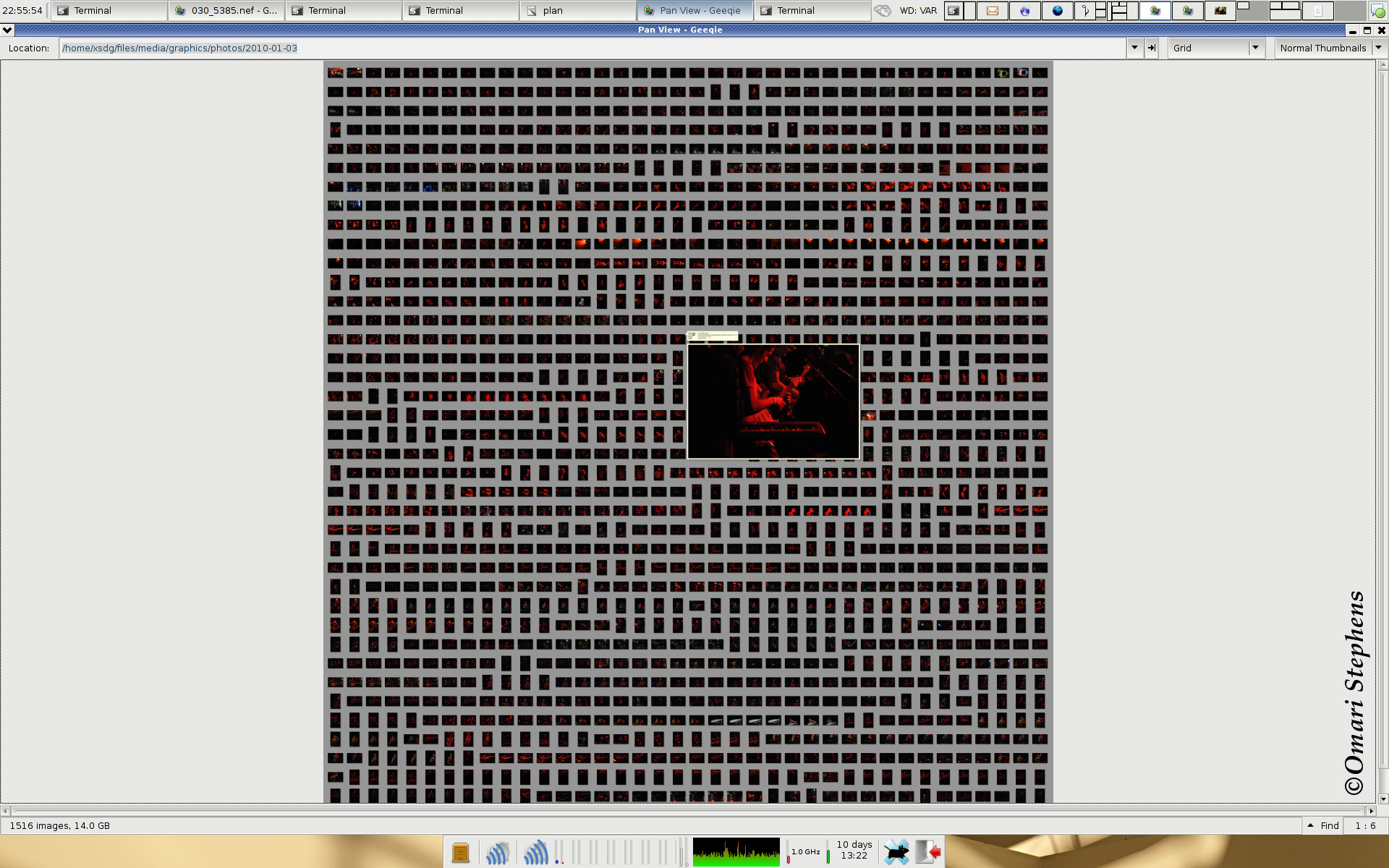
Screenshot of Geeqie panview
Some nights I take a lot of photos. Click the image above to see the full-resolution screenshot.

I'm in the process of putting together an actual blog post, and figured I'd do a short segment on how "event happens; Omari takes photos" turns into an actual blog post.

First, I sift. I might start with many hundreds of photos, but eventually I usually try to whittle it down to between 5 and 10 that help anchor and illustrate the story I'm trying to convey. Depending on how much I've shot and whether I know what I'm looking for, this can take as little as an hour or as long as a few weeks, off and on.

Once I have the photos picked out, I drop them into my empty blog post template and then start writing. Sometimes the story develops in a direction I didn't predict, and I end up swapping out certain photos for more appropriate ones. Other times, I learn neat tidbits in the research I invariable do as I write; I'll usually drop a link in when there's something interesting or useful at the other end.

All along the way, I edit fastidiously. And when all's said and done, I'll typically have spent somewhere from 4 to 6 hours on writing for each post.

After I hit the orange "Publish Post" button, I send post notifications and then I often go to sleep :o). Ways that you can follow The Doppler Effect include: Well, that's all for now. I'm looking forward to getting this next post done and out the door, and here's hoping for a productive 2010. Cheers :o)

04 August, 2009

On Printing (Print On)

Very nearly a year ago, I mentioned in a post on this very blog that I was hunting for ways to make my photography foot its own bill. I mentioned at the time that I was looking into stock photo sites like Photo Shelter, as well as online print houses such as MPix. Quite fittingly, this printing press photo was one of the images that appeared in that post.

In the time between then and now, I've done a lot of reading, a lot of research, and even some soul-searching. This past Sunday, I came up with a plan. Now, the plan is in action.

So here's how this goes. The images are now links. If you like a photo, or if you want to see a bigger version, just click it. You end up at a place where you can see larger versions, get prints, or possibly just browse through the photos without having to jump from post to post. My other gallery will remain as a place to see photos in high volume. This new site will be a place to see them in high quality.

To get a print, click the photo here, then look for the "Add to Cart" button in the top-right corner of the screen or in the pop-up menu of the image on that page. You'll then be able to pick paper size, quantity, finishing options (like mounting and framing), and all that jazz. Checkout is quick and easy; you don't have to get an account to buy things, and can pay with a credit card or PayPal. And to give you an idea, a few prices are $2/$4 for a 4x6, $6 for a 5x7, and $8 for an 8x10. I might end up changing things around a bit, though; feel free to complain.

If you're interested in a photo I don't have up, just send me an email or leave a comment, and I'll do my best to have it up in the Requests gallery within 24 hours. I keep almost every photo I've ever taken, so feel free to ask about photos I may have shot for The Tech, or even before that. Also note that I've only gotten through the July and August blog photos so far. I'll be working to get through the rest of them in reverse chronological order throughout the next week or so.

*Phew* It's been a long time coming. If you're interested, there are more details below. Either way, I really like this quote from Magnum photographer Elliott Erwitt, "I guess if you take a picture and you want to have a certain meaning, and people get that meaning, that's nice. Otherwise people can like my photos on any level and I'm happy."


This is a photo of Graham Ramsay, an artist and a mentor to many, and one of my photographic mentors for a few years, now. Here, he's looking through some medium-format negatives that a friend, Biyeun, had shot during her time in Uganda.

Now, the gory details: As part of my research, I ordered around 40 prints from the MPix lab, including a couple 12"x18"s, on Thursday evening, 18 December. That's only a week before Christmas. MPix whipped through the prints on Friday and shipped them out that same day. I had the prints in hand Monday morning, with hours and hours to spare before I left the country that evening.

So MPix is incredibly timely. Beyond that, the prints were stunning, and the packaging was fantastic. It was more than sufficient to give me confidence that anything I order will arrive in perfect shape, but also not so bulky as to be wasteful.

Around the same time, I saw an email that MPix was teaming up with Zenfolio to provide a gallery solution for photographers. I failed to put two and two together and look into Zenfolio until a few weeks ago, which was a major oversight.

When I finally looked, I was set to dismiss it when I saw this amazing waterdrop photo on their homepage. I looked to see if the photographer had other nice photos (he does), and the interface sort of grew on me. The site is super-slick, incredibly well-thought-out, and fast. It does what you need and gets out of your way.

So this past Sunday, I started thinking that Zenfolio might be for me. I searched around a bit and all I could find were rave reviews, including one back from 2006. In addition to seeing that they were well-liked, it was also reassuring to learn that they've been in business for at least a couple years, now. That same night, I got an account, messed around a bit, and have been frantically processing and uploading large versions of the blog photos since then. There are a lot more nights of frenzied photo-editing ahead, but at least for this first milestone, the end is in sight.

"Just don't give up trying to do what you really want to do. Where there is love and inspiration, I don't think you can go wrong."
—Ella Fitzgerald

24 August, 2008

Steps Toward Self-Sufficient Photography

I take photos. Sometimes with varying quantities of hair (1/200s, f/10.0, ISO400). As a result I usually want things that will make taking photos easier. Unfortunately, these things cost money, and since this is photography, these things can cost a lot of money.

So, one goal of mine is to make my photography pay for itself. One way to do this is by licensing images through a site such as Photo Shelter. I'll likely pursue this once I get close to the end of picking out photos for my portfolio. That's a decent way off, however.

Another way to make money with photography is to sell prints. At the start, it's foolish to try to beat the economy of scale of online print shops, provided that they can provide prints of sufficiently high quality. And what better way to verify print quality than by getting a few prints done?

So, for now, I'm investigating MPix on the recommendation of Geoff Young of Crushed Red Pepper; primarily because he uses a workflow that's fairly similar to mine.

That said, the rest of this post will consist of anecdotes about a few photos I'm considering getting printed. The twin goals of this experiment will be to see how MPix's print process deals with various types of photos that I take, and to get pretty prints that I can enjoy for myself. Yay!

Now let's start things off with a bang.


This was taken in the middle of the night, somewhere at MIT. It was a lot of fun to watch, and it was considerably warmer and brighter than I expected. Thanks to the magic of automatic exposure calculation and surprisingly good timing with the shutter release, I shot this at 1/800s at f/5.6 and ISO400. And then we all scattered.


At the end of every volume, the staff of The Tech would generally take a trip to our publisher, Charles River Publishing, to see how they turned our PDF proofs into a physical newspaper. We would typically head out around 4:00 am, watch CRP turn out our 8,000-issue run, and then have breakfast at a diner near Belmont. As with most Tech outings, the photogs (including Yours, Truly) brought what cameras they could. This was 1/100s at f/4.0 and ISO800.


Bike polo is a lot of fun, both to watch and to play. On this occasion, though, I was on the sidelines, watching a tournament amongst polo teams of 3. To up the ante, a bunch of folks from New York had come down to Boston to hang out, to have fun, and as became readily apparent, to kick some butt. This guy was a Boston polo regular. 1/1000s at f/5.6.


As I mentioned off-hand in my post from New York, I shot a lot of fire engines at MIT. This is one such beast. It was the middle of December, and I had been shooting snow-related traffic to potentially illustrate an inevitable snow-related story.

When I was done, I got back to the office, someone mentioned a fire alarm at the Media Lab, and I was off again. For reasons of dexterity, I ended up doing most of the shooting with no gloves on — the photos turned out well, but my hands were totally numb by the end of it. Anyway, 1/80s at f/3.5 and 18mm (27mm equiv.)


In addition to the fire engines, I shot a lot of concerts, and improved significantly at shooting them throughout my four years at MIT. One of my favorite groups, both to shoot and to listen to, was the Festival Jazz Ensemble.

Late in the summer of 2007, Jazz great and FJE founder Herb Pomeroy passed away. In his honor, the FJE sponsored a memorial concert, held on Saturday, May 10th, 2008, which featured the FJE, an alumni band, as well as performers from the area who had performed with Pomeroy. Here, Jazz pianist Harvey Diamond stands after playing Ellington's "Don't You Know I Care?" 1/60s at f/2.8 and ISO500.

To conclude, an unattributed quote:
"Life isn't about waiting for the storm to pass, it's about learning how to dance in the rain."